Monday, January 30, 2012

FROM RUSSIA WITH LOVE


(October 1963, U.S.)

If DR. NO (1962) was the opportunity for the brand new James Bond film franchise to get its feet wet, then the second one, FROM RUSSIA WITH LOVE, was the film that solidified many of the Bond elements and standards we've come to love and expect, including the pre-title opening white circle accompanied with the traditional opening theme, percussive themed "007" action music by John Barry, "Q" branch equipment as well as the characters of "Q" himself and Ernst Stavro Blofeld (identified only as "Number #1 here). This film is also one of the few (aside from QUANTUM OF SOLACE) that serves mildly as a direct sequel from its preceeding film. Listen carefully for the mention of Dr. No's name, Bond's previous trip to Jamacia and a very brief return of Sylvia Trench's character.

Although a lot more low key than many "high octane" Bond films, FROM RUSSIA WITH LOVE is based on the 1957 novel of the same name by Ian Fleming. In this story, Bond is sent to assist in the defection of Soviet consulate clerk Tatiana Romanova (played by Daniela Bianchi) in Turkey, where SPECTRE plans to avenge Bond's killing of Dr. No. Along the way, he must do battle with ex-SMERSH operative and SPECTRE Number #3 Rosa Klebb (played by Lotte Lenya) in a role that, frankly, has come to define the true meaning of "DYKE" in my book (sorry for the very un-PC word there, but just take a look at the character and tell me you don't agree with me. The truth is an ugly and un-PC thing sometimes) and Red Grant, a cunning SPECTRE assassin and one of the most devious enemies Bond has ever faced.

Now speaking of Red Grant, let me get into that character for a moment. Over the course of my childhood in the 1970s and 1980s, I got to know actor Robert Shaw (not personally) a bit in films like THE STING (1973), JAWS (1975), BLACK SUNDAY (1977) and THE DEEP (1977). There is an irresistable intensity and seriousness about him that brings out unforgetable performances in everything he's done. As Grant, though, his dialogue is minimal. In this role, it's his physical presence, his body language and almost creepy silence that makes him a deadly character. Bond history will often cite secondary evil characters as Oddjob (GOLDFINGER) and JAWS (THE SPY WHO LOVED ME and MOONRAKER) as the more memorable ones. But in my book, it's Robert Shaw as Red Grant that gets my vote. As a trademark Bond girl, Daniela Bianchi is beautiful and sexy, but I'm afraid that's about it. Her character is almost pointless except to accompany our hero along the adventure. In other words, she's not the worst Bond girl (Denise Richards still holds that title!), but she's hell and gone from being the best, either.

By the way, the next time I discuss a Bond film, it'll be a double-feature post, so to say. Can you guess what they'll be?

Favorite line or dialogue:

Tatiana Romanova: "The mechanism is...oh James, James...will you make love to me all the time in England?"
James Bond: "Day and night. Go on about the mechanism."

Sunday, January 29, 2012

FROM HERE TO ETERNITY


(August 1953, U.S.)

Some time ago, I gave you my own classifications of war films as being divided into either combat films or war dramas. Every once in a while, though, you'd get a film that combines a touch of both. FROM HERE TO ETERNITY is primarily a war drama, but you do get a little taste of combat in the end. The story deals with the troubles of soldiers and the women in their lives stationed on Hawaii in the months leading up to the attack on Pearl Harbor on December 7, 1941.

Even if you've never seen or even heard of this film, you've very likely seen the iconic image of Burt Lancaster and Deborah Kerr making out on the beach as a wave breaks over their bodies. Take a look...


I point this out because one of the first elements of FROM HERE TO ETERNITY that captures the eyes is the crisp breathtaking black and white cinematography of the beaches of Hawaii. It's also an intruiging point to know from the beginning that this is a film that takes place in Hawaii in 1941. You don't have to be a genius to how it's all going to turn out in the end. As a viewer, you can't help but take a slightly higher interest in the outcome of the lives of characters that are destined to become a part of world history. Private Robert E. Lee Prewitt (played by Montgomery Clift) is a good man and a good soldier who only wants to do his American duty and avoid the boxing ring due to a past accident, despite the ongoing pressure he's getting from fellow soldiers to be a part of the Army's boxing team. He's a man that's also struggling to love Lorene (played by Donna Reed), an employee at a gentlemen's club, despite his daily anguish and her desire NOT to end up as a soldier's wife. First Sergeant Milton Warden (played by Lancaster) is a man with very much in common with Prewitt, as he, too, struggles with his own pressures as a soldier and his conflict with being in love with his commanding officer's wife Karen (played by Kerr). Life in the military CAN be a bitch, can't it!

The inevitable attack on Pearl Harbor at the end is brief, but filmed with both on location action and with stock footage of the real attack itself and it's explosive aftermath. It's not a film that ends with heroes, but serves rather to remind us that the rather "petty" issues of these men and women that we've been watching for the past two hours have now become virtually non-existent...for the country is now at war and all must come together to fight our enemies. Many will live and many will die, but we already know that America triumphed!

FROM HERE TO ETERNITY won the Oscar for best picture of 1953.

Favorite line or dialogue:

Karen Holmes: "Come back here, Sergeant. I'll tell you the story; you can take it back to the barracks with you. I'd only been married to Dana two years when I found out he was cheating. And by that time I was pregnant. I thought I had something to hope for. I was almost happy the night the pains began. I remember Dana was going to an officers' conference. I told him to get home early, to bring the doctor with him. And maybe he would have...if his "conference" hadn't been with a hat-check girl! He was drunk when he came in at five AM. I was lying on the floor. I begged him to go for the doctor, but he fell on the couch and passed out. The baby was born about an hour later. Of course it was dead. It was a boy. But they worked over me at the hospital, they fixed me up fine, they even took my appendix out - they threw that in free."

Saturday, January 28, 2012

FROM DUSK TILL DAWN


(January 1996, U.S.)

A vampire horror film with the dialogue and wit right out of PULP FICTION? How could that be possible? Vampire films are usually badly acted trash with roman numerals in the title. The answer is very simple, my friends - Quentin Fuckin' Tarantino, that's how! It's actually almost a shame that the film was billed as a vampire adventure from the time of its release because much like Hitchcock's PSYCHO (1960), it's a film that's starts out one way and then shifts gears entirely into a totally different direction. Imagine the shock and surprise audiences with wild imaginations would have experienced if they walked in expecting a heist and getaway film and then ended up with fucking vampires?

Now let me start by saying that I never watched an episode of TV's ER in my life. So FROM DUSK TILL DAWN was really my first exposure to George Clooney, and I have to say, I was absolutely blown away by what a fast talking, sharp shooting, badass criminal motherfucker he was. And speaking as a very self-confident heterosexual make, I can understand why women all over the world wanted to drop their panties for this guy.

So here's how it goes - two brothers Seth (played by Clooney) and Richie Gecko (played by Quentin Tarantino) are wanted by the FBI and Texas police for a bank robbery that has left several people dead. They're heading for the Mexican border, where a contact named Carlos has arranged a safehouse for them. Along the way they stop at a motel and it's revealed that they'd been keeping a female bank teller in their car trunk as hostage. Unfortunately, she doesn't last long because Richie has this nastly tendancy toward rape and violent homicide. Their "plan B" now to get across the border is to kidnap a father, his two teenage kids and their RV. Getting across the border is actually easy and almost immaterial compared with what's going to happen to them when they reach a place called "The Titty Twister" (my kinda place!), open from dusk till dawn.

By the way, let me interrupt for a moment by saying that like Peter Sellers in DR. STRANGELOVE (1964), Cheech Marin plays three different roles in this film. None better, though, than the the doorman Chet Pussy. His welcome speech to the world of pussy that's inside the strip club is one of the funniest things I've ever listened to; worth the price of the movie ticket alone.

So, back in the club, things are getting sexy, crazy and very tense, and that's BEFORE we learn that we're in a club belonging to vampires who have a history of feeding on truckers and bikers for years. But like any other vampire flick, you also have your vampire fighters who ultimately end up being real grande heroes. So Seth, the previous badass criminal motherfucker, is now our biggest hero with a gun and a wooden stake. Vampires die (explode and melt, actually), good guy (and girl) live and all will be right with the world when the evil bank robber gets away and rides off into the sunset with his stolen money. Yes, people, there's nothing like a big beautiful Hollywood ending to put a smile on your face!

Let me reitterate that while this is a vampire film in all its silly traditional sense, it's also primarily a dialogue film, which is what ultimately holds my attention most. Sure, any "twilight" tweenie can be a vampire and any "Buffy" type slut can slay them. But when George Clooney is shooting off his mouth at a constant rate with dialogue written by Quentin Tarantino...that my friends, is a fucking vampire movie!!!

Favorite line or dialogue:

Carlos: "What were they, psychos or...?"
Seth: "They look like psychos? Is that what they looked like? They were vampires! Psychos do not explode when sunlight hits 'em! I don't give a fuck how crazy they are!"

Thursday, January 26, 2012

FRIED GREEN TOMATOES


(December 1991, U.S.)

FRIED GREEN TOMATOES is one of those dramas that I find necessary to revisit every once in a while to remind myself of a time when major studios like Universal were still releasing Oscar-worthy films that didn't involve special effects or any computer generated bullshit. It's also happens to be a damn good movie. It tells the story of a Depression-era friendship between two women, Ruth (played by Mary Louise Parker) and Idgie (played by Mary Stuart Masterson), and a 1980's friendship between Evelyn (played by Kathy Bates), a middle-aged housewife, and Ninny (played by Jessica Tandy), an elderly woman who knew Ruth and Idgie when they were young. The centerpiece and parallel story concerns the murder of Ruth's abusive husband and the accusations that follow. And as a predictable Hollywood move, the lesbian content from the original novel is generally removed. Still, if you're paying close enough attention and reading between the lines, you can clearly see the "intent", no matter how ambiguous.

The film's subplot concerns Evelyn's dissatisfaction with her marriage and her life, her growing confidence, and her developing friendship with Ninny. The narrative switches several times between Ninny's story, which is set between World War I and World War II, and Evelyn's life in 1980's Birmingham. Through Ninny's story of Ruth and Idgie, Evelyn manages to find her own sense of strength and self-worth. It's impressive and even fun to watch her finally takes charge of herself and even display anger that's necessary to combat everyday people who are rude and inconsiderate. The scene with the parking space is practically classic in that I'm sure we're all wanted to take some sort of action against assholes who take the space we were waiting for.

Two spoilers coming now: the final scene of FRIED GREEN TOMATOES is quite intruiging when Evelyn and Ninny pass Ruth's grave (she died young of cancer), freshly adorned with a jar of honey and honeycomb and a card which reads " I will always Love You. The Bee Charmer," Ruth's old nickname for Idgie. It becomes apparent that Ninny WAS Idgie and has been telling the tale of her own life the entire time. It's a revelation that could be called predictable, but it puts an irresistable smile on your face, nonetheless.

Favorite line or dialogue:

Evelyn Couch: "Excuse me, I was waiting for that spot."
Girl #1: "Face it, lady, we're younger and faster!"
(Evelyn gets angry and rear-ends the girl's car six times)
Girl #1: "What are you DOING?"!?
Girl #2: "Are you CRAZY!?"
Evelyn: "Face it, girls, I'm older and I have more insurance."

Wednesday, January 25, 2012

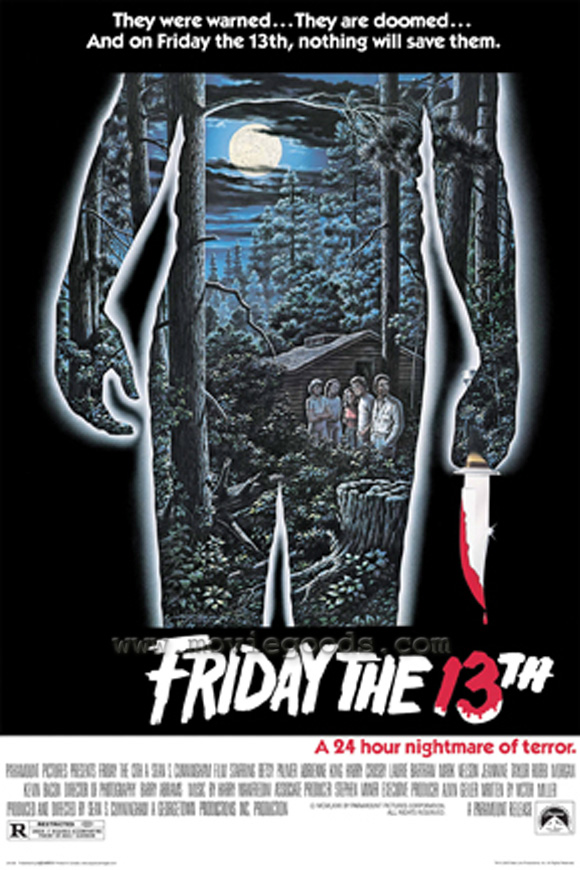
FRIDAY THE 13TH (1980)


(May 1980, U.S.)

Sometimes in life, we choose to perceive things (and movies) from our own personal perspective as opposed how they actually happened. That being the case, I choose to own and remember the original FRIDAY THE 13TH as a stand-alone horror film released at a time when horror films were being released in droves and at a time when, just like HALLOWEEN (1978), using the name of an actual day of the year that summons up dread would likely mean box office gold. So people, as far as I'm concerned, Jason Voorhees was never the primary antagonist of the movie, there never was a hockey mask, Jason never was in 3D, Jason never ended up in outer space (???) and there never was a crossover with Freddy Kruger. So while you're reading this post, try to open your mind a bit and pretend that this original horror film never eroded into an out-of-control franchise that, in my opinion, defines the horrors of overkill.

As storyline goes, FRIDAY THE 13TH is not the most original thing ever written. The film concerns a group of teenagers who are murdered one-by-one by a mysterious killer while attempting to re-open the abandoned summer Camp Crystal Lake. The key to the creepiness of this film lies in the shadows of the deep, dark woods, the stories and history of the Camp Crystal Lake curse and (as much as I hate to admit it), that kooky "Ch-ch-ch-ha-ha-ha!" musical soundtrack. There's also a particular creepiness in the scene where one of the would-be counselors hears a child-like voice calling "Help me!" from the woods and then she inevitably meets her doom at the archery range during a harsh rain storm. Poor Brenda!

There's something in film script writing known as "set up" and "pay off". In the case of this film, there's a scene in the beginning where a common truck driver warns a young girl about Camp Crystal Lake and very casually mentions a boy drowing in 1957. It's mention very quickly and the first time viewer is very likely to dismiss it immediately. It's only later in the film when that very mild "set up" actually "pays off" when we learn that the boy who drowned in 1957 is the entire reason the murders are taking place by his psychotic, grieving mother. Yes, I have to admit that even I was surprised to learn that the killer was a woman the first time I ever saw FRIDAY THE 13TH. I've also enjoyed the ambiguity of little, demented and disfigured Jason rising out of the lake to take down the only survivor of the night's masacre. Did it really happen? Does Jason really live? Like I said before, this is how I choose to perceive things and not necessarily how they actually happened.

By the way, did you know that Camp Crystal Lake is supposed to be somewhere in New Jersey? As if that poor state didn't need ANOTHER reason to be mocked!

So there you have it people...if you can just choose to ignore all the hockey mask franchise bullshit for just a little while, you're likely to discover (or RE-discover) that the original 1980 version of FRIDAY THE 13TH is actually a worthwhile horror experience. Give it a try.

Favorite line or dialogue:

Alice: "The boy...is he dead, too?"
Officer Tierney: "Who?"
Alice: "The boy...Jason."
Tierney: "Jason?"
Alice: "In the lake, the one...the one who attacked me...the one who pulled me underneath the water."
Tierney: "Ma'am, we didn't find any boy."
Alice: "But...then he's still there."

Yes, and that's where Jason should've stayed!

Tuesday, January 24, 2012

FRENCH CONNECTION, THE


(October 1971, U.S.)

To put it simply and plainly, William Friedkin's THE FRENCH CONNECTION is, has always been, and will continue to be my all-time favorite crime thriller. Especially today, when our society has become so pathetically concerned with being so verbally politically correct and watching what we say around others, it's almost refreshing to return to a character like Jimmy 'Popeye' Doyle, a Brooklyn narcotics detective who is, in my opinion, exactly what every movie cop should be; a though, no-nonsense racist pig!

Now, you may have heard me tell you what a shithole I think Brooklyn is. Well, this is 1971, and as you watch the movie, it's difficult to imagine Brooklyn (and ALL of New York City, for that matter) to be any more ridden with crime and filth than it does at this time. But a hard edge thriller of this sorts would likely not work today in a city that has gotten "cleaned up" over the last two decades. If you ever lived in or grew up around Manhattan or Brooklyn, it can be quite a visual trip looking at the city as it appeared forty years ago, especially if you happen to catch a glimpse of one of the twin towers of the World Trade Center still under construction.

The film revolves around the smuggling of narcotics between Marseilles, France and New York City. In New York, detectives Doyle (played by Gene Hackman) and Buddy 'Cloudy' Russo (played by the great Roy Scheider) are the ones who almost accidentally stumble upon a possible major narcotics score that going to come into New York in the next few days and proceed to investigate "the French connection" in the case. Doyle becomes obssessed with not only breaking the case, but also catching Alain Charnier (played by Fernando Rey), the French criminal responsible for smuggling the heroin from France to the United States. Much of the film serves as a game of cat-and-mouse between cops and criminals and it's impossible not to become caught up in every step of the action, especially with the accompanying soundtrack. Doyle is a good cop but the man hates, too; hates criminals, hates the FBI and hates the rich. Watch carefully, the contempt on his face as he stands outside in the brutal and depressing New York cold weather staking out two criminals across the street enjoying a luxurious lunch at a fancy French restaurant while he feasts on a mere slice of pizza and some very bad coffee.

Getting back to the action, let's talk about that incredible car chase for a moment. With all due respect to Steve McQueen in BULLIT (1968), it's an almost psychotic Doyle chasing an elevated subway train through the streets of Brooklyn that has and always will get my personal award for best car chase scene in a film EVER! If you've seen this, then you know exactly what I'm talking about. You'll also know that this sequence was filmed on location with a real car and a real driver. Yes, it was all real. No computer or special effects bullshit here!

THE FRENCH CONNECTION is not only a film I enjoy revisiting when I want the best damn crime thriller ever made, but also a rather bizarre nostolgic look back at New York City and how it used to look , good or bad. It's also a story that I like to leave ambiguous in my own mind when Charnier gets away at the end. In other words, I choose to ignore the fact that there was a FRENCH CONNECTION II four years later.

THE FRENCH CONNECTION won the Oscar for best picture of 1971. It was also the first R-rated film to do so since the introduction of the MPAA film rating system.

Favorite line or dialogue:

Jimmy: "You dumb guinea."
Buddy: "How the hell was I supposed to know he had a knife?"
Jimmy: "Never trust a nigger."
Buddy: "He could have been white."
Jimmy: "Never trust anyone!"

See what I mean? Very "un-PC" dialogue, but it still works for the character and the setting.

FRANKENSTEIN


(November 1931, U.S.)

In 1931, Frank Whale's film version of Mary Shelley's FRANKENSTEIN was indeed the horror show of the ages. The film begins with actor Edward Van Sloan stepping from behind a curtain and delivering a "friendly warning" before the opening credits:

"How do you do. We are about to unfold the story of Frankenstein, a man of science who sought to create a man after his own image without reckoning upon God. It is one of the strangest tales ever told. It deals with the two great mysteries of creation – life and death. I think it will thrill you. It may shock you. It might even – horrify you. So if any of you feel that you do not care to subject your nerves to such a strain, now's your chance to – uh, well, we warned you."

Imagine sitting in the movie theater in 1931 and hearing those piercing words and wondering in frightening anticipation what was to come on the screen. Imagine sitting there and seeing Boris Karloff in that scary makeup and flat head staring you in the face for the first time and feeling the shivers travel up and down your spine. It's probably difficult to do given the extremes that horror films have gone to over the decades, but on the other hand, if you're sitting in a dark living room and watching a real sharp DVD copy of FRANKENSTEIN, you just might feel an ounce of those shivers I was talking about, even in this modern day and age.

The use of one's open mind and imagination is key not only in the horror of Karloff's appearance, but also in the premise of an eccentric scientist taking the laws of life, death man and God into his own hands as he attempts to create his own human being in his own image by stealing dead body parts from frest graves and brains from medical college classrooms. It's inevitable that the creation will ultimately turn on his creator, as well as surrounding society itself. Many film scholars will note that the creature is supposed to be a sympathetic character, but I've always found that a difficult premise to accept when witnessing the horror and havoc the monster causes throught the village. Even when he's being hunted by the villagers and it appears that he will burn to death in the windmill inferno, his ear-piercing harsh screams are still frightening and one can't help but feel that the creature MUST die.

If you're not already aware of this, the film has an interesting history of censorship issues regarding the scene in which the monster throws the little girl into the lake and accidentaly drowns her. Upon it original 1931 release, the second part of this scene was cut by state censorship boards in Massachusetts, Pennsylvania and New York. Those states also objected to a line they considere blasphemous, during Dr. Henry Frankenstein's exuberance when he first leans that his creature is alive and openly declares himself on par with the likes and powers of God himself. Those sequences were tragically cut from the film over the years but thankfully, over additional time, those points of controversay have been restored to the film's original intent, as they should be.

FRANKENSTEIN may not have been the very first of the legendary Universal Studios monster movies (DRACULA was), but it is, by far, the best of all that have ever been made, in my opinion. It's a trademark of true classic horror and a remainder to my own personal memories of all those late night horror movie TV presentations like "Fright Night" and "Chiller Theater". And by the way, when exactly did the name lf "Frankenstein" eventually pertain to the monster himself when its original intention was for that of the doctor himself? When did that happen?

Favorite line or dialogue:

Henry Frankenstein: "Look! It's moving. It's alive. It's alive...it's alive, it's moving, it's alive, it's alive, it's alive, it's alive, IT'S ALIVE!"
Victor Moritz: "Henry, in the name of God!"
Henry: "Oh, in the name of God! Now I know what it feels like to be God!"